Don’t Blame the Teachers—They’re Prisoners Too
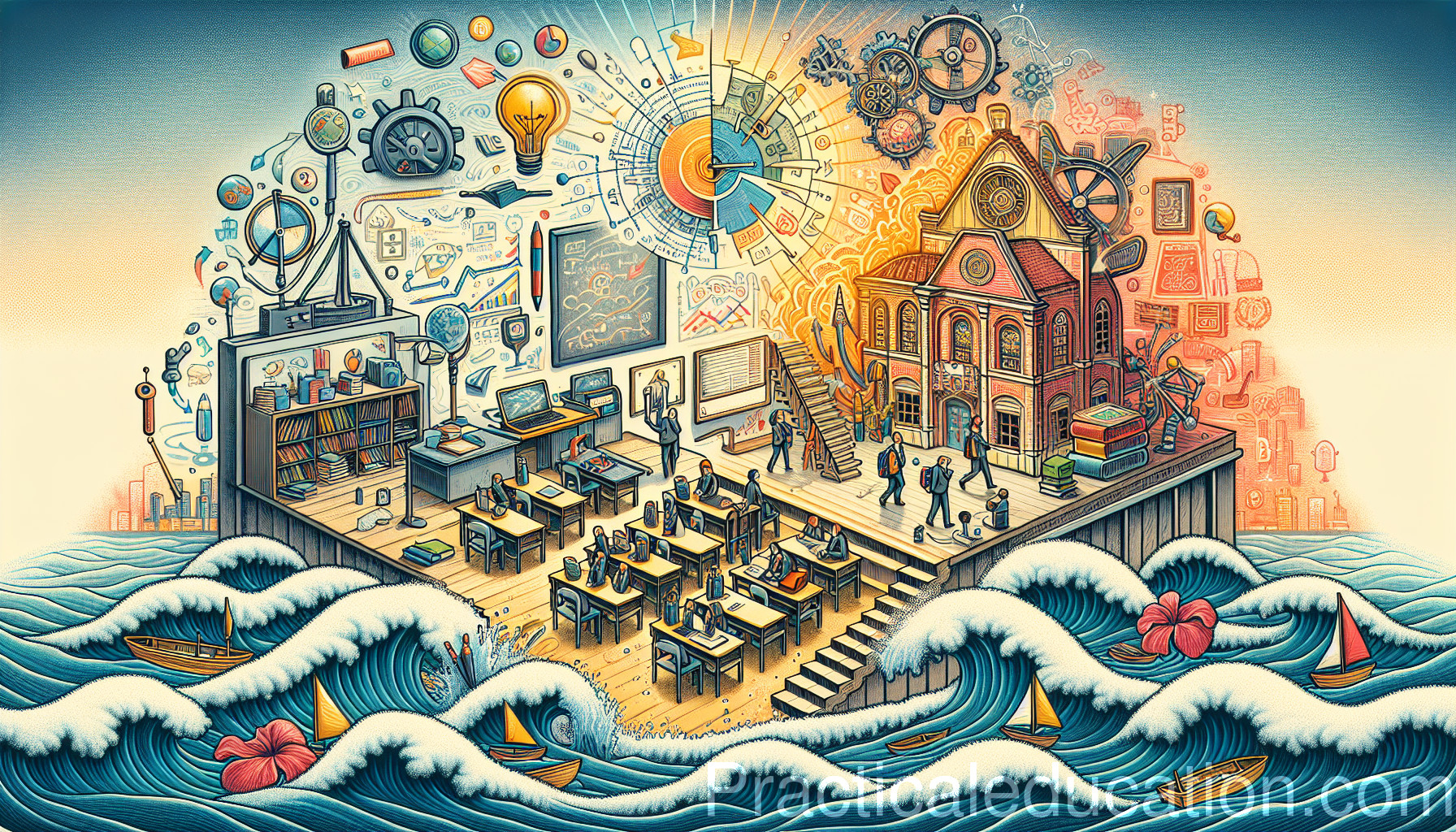
The problem isn't the people—it’s the prison. Teachers are often the most passionate, brilliant minds trapped in the most limiting cages. They’re forced to obey rigid syllabi, chase meaningless grades, and discipline creativity instead of nurturing it. We don’t need to replace them—we need to release them. A revolution that doesn’t free teachers will never free students.
The problem with contemporary education lies not only in the content it delivers but in the very structure of the systems designed to impart that content.Teachers, who are often the most dedicated and knowledgeable individuals in the educational ecosystem, find themselves constrained within a system that prioritizes standardization over substance.
This chapter posits that the issue is not the educators themselves, but rather the rigid, antiquated frameworks within which they operate—a prison that limits both their potential and that of their students.
For meaningful reform to take place, it is essential to restructure the educational environment so that it promotes freedom, creativity, and practical skills development over rote memorization and compliance.
The prevailing educational model is predicated on a series of outdated beliefs: that knowledge is something to be poured into students’ minds in preparation for standardized assessments, that compliance is synonymous with discipline, and that educational success is measured through grades and credentials.
In reality, these beliefs serve only to reinforce a culture of mediocrity, stifling innovation and critical thought.
Teachers, trained extensively in their fields, are often forced to adhere to narrow curricula that require them to teach to the test, leading to disillusionment and a lack of engagement.
This stifling of pedagogical flexibility prevents educators from fostering authentic learning experiences tailored to the unique needs and interests of their students, reducing the role of teachers to mere facilitators of a predetermined agenda.
Despite their constraints, teachers possess immense potential to inspire and engage students if given the freedom to diverge from conventional practices.
A truly effective education system must recognize that teachers are not the enemy of change but are instead its key architects.
By granting them autonomy over their curricula, we can leverage their expertise to create learning environments that emphasize real-world application and critical thinking.
Such an approach would empower teachers to craft innovative projects, engage in interdisciplinary teaching, and cultivate students’ problem-solving abilities, all of which are essential skills in a rapidly changing job market.
Revolutionizing education necessitates a departure from a compliance-based system towards one that embodies principles of entrepreneurship and adaptability.
This shift can only occur when educational institutions empower teachers as agents of change, fostering an environment that encourages exploration, experimentation, and experiential learning.
Curriculum design must be reimagined to prioritize practical skills that are applicable in real-world contexts, allowing students to engage in projects that have tangible outcomes.
This not only makes learning relevant but also instills a sense of ownership and accountability in students, qualities that are vital for personal and professional success.
Such an educational shift would also benefit from global perspectives.
Western educational models often emphasize individualism and competition, which can stifle collaboration and community-building.
Conversely, Eastern approaches generally focus on collectivism and a deep respect for foundational knowledge.
By combining the ingenuity of the Western entrepreneurial spirit with the depth and adaptability inherent in Eastern philosophies, an educational framework can emerge that values both individual initiative and communal responsibility.
This synergy can lead to a more holistic education that prepares students to thrive in diverse environments and addresses the complexities of a globalized world.
The implications of this transformation extend beyond individual classrooms.
Educational institutions would need to restructure their cultures to support teacher autonomy, creating professional development programs that prioritize innovative teaching methods and provide ongoing training in practical skill sets.
Additionally, assessment practices must evolve to evaluate student learning in ways that reflect real-world competencies rather than compliance with rote standards.
By fostering a culture of trust and support, schools can become incubators of creativity, where both teachers and students thrive.
Higher education institutions similarly face the challenge of aligning curricula with the needs of a global economy.
The traditional model of university education often prioritizes theory over practice, producing graduates who are well-versed in concepts but lack the skills needed for effective application.
Institutions must seek partnerships with industries to develop programs that offer internships, apprenticeships, and hands-on experience in real-world settings.
This collaboration not only enhances students' employability but also provides valuable feedback to educators about changing workplace demands, facilitating ongoing curricular refinement.
In considering the role of technology in this educational revolution, it is crucial to acknowledge that digital tools should enhance rather than replace the human elements of teaching and learning.
Online platforms can serve as valuable resources for collaboration, allowing teachers to share innovative practices and students to access a wealth of knowledge beyond their immediate environment.
However, reliance on technology must be balanced with the understanding that interpersonal skills and emotional intelligence remain fundamental to success in any career.
Thus, any integration of technology into educational practices must be accompanied by strategies that promote engagement, creativity, and real-world problem-solving.
To summarize, the core of educational reform lies not in replacing teachers but in liberating them from the confines of traditional schooling.
This liberation requires a fundamental redesign of curricula, an emphasis on practical skills, and a global perspective that cultivates both individual and collective capacities.
By reframing educational institutions as environments that prioritize autonomy, creativity, and real-world learning, we can dismantle the myths that have long governed education.
Teachers, empowered as facilitators of practical application, will inspire students to embrace their own journeys toward mastery and ownership.
The true measure of an educational system is not its ability to produce a standardized class but rather its capacity to nurture the unique talents and skills of each individual within it.
In this context, the potential for teachers and students alike is limited only by the structures that confine them.
“Education is not a cage; it is the key to unlocking potential.” — Eric Bach