Pythagorean Trap
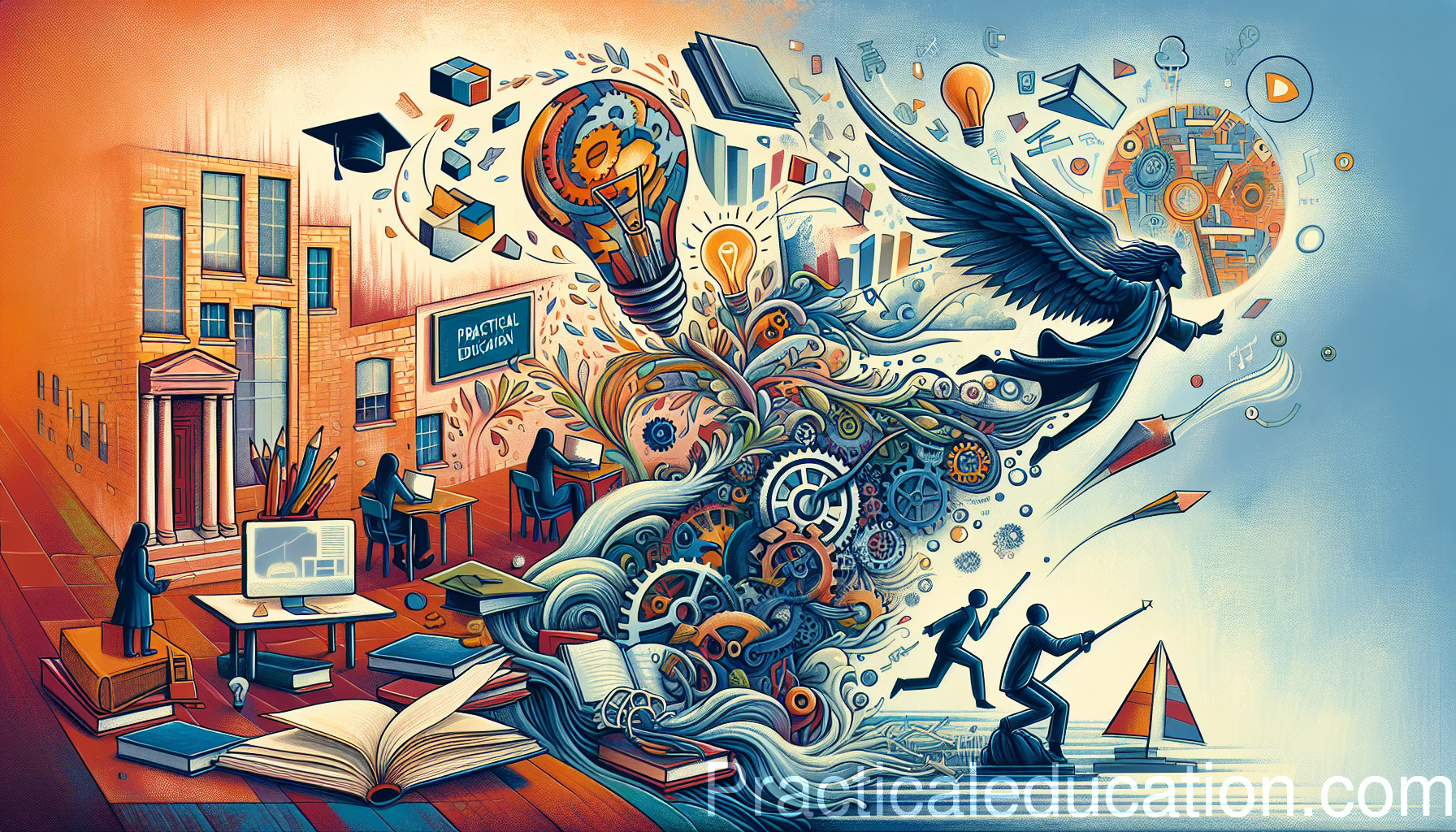
We celebrate knowing the Pythagorean theorem—but we can’t explain how compound interest works. Students are buried in theorems but starve for truth. We must stop prioritizing abstract math over applicable mastery. Geometry never taught a child how to dream.
The traditional model of education often places a disproportionate emphasis on abstract concepts and theoretical knowledge at the expense of practical skills and real-world application.This is evident in the way students write tests to demonstrate understanding of the Pythagorean theorem while remaining ill-equipped to tackle essential real-life scenarios, such as understanding compound interest or making informed financial decisions.
The Pythagorean theorem, a staple of mathematics curricula worldwide, is rarely contextualized in a manner that connects it to students’ immediate realities.
In contrast, compound interest, an essential concept for financial literacy, remains largely absent from discussions in many educational frameworks.
This chapter argues that a realignment of educational priorities is necessary, one that transcends mere memorization and theory, and instead centers on applicable mastery—skills and knowledge that empower students with ownership over their learning and their lives.
To dismantle this entrenched model, we must first recognize the limitations of celebrating abstract knowledge—specifically within mathematics.
The Pythagorean theorem can be taught as a beautiful mathematical truth, yet the absence of practical application reduces its value in a student's life.
Mathematics education should be restructured to include real-world applications from the outset, fostering an understanding of mathematical principles that students can relate to their daily lives.
For instance, rather than solely proving and applying geometric theorems, curricular frameworks should integrate financial literacy topics like interest calculations, savings, investments, and budgeting.
This pivot not only equips students to navigate personal finance but also cultivates a mindset geared toward entrepreneurship, a competency that transcends geographic and cultural boundaries.
Curriculum design must evolve from content-driven learning to experience-driven engagement.
Schools should prioritize courses that emphasize skill acquisition across disciplines, thereby preparing students to approach real-world challenges with confidence.
Project-based learning, for instance, encourages collaborative products that are directly linked to students’ interests in practical applications.
A curriculum that features modules specifically aimed at solving community problems—such as developing a neighborhood garden, creating a local business plan, or conducting environmental impact assessments—fosters both autonomy and agency, allowing students to interact with the material in a meaningful way.
Such experiential learning can enhance student motivation and achievement, as students see the tangible results of their endeavors.
Implementation of this revised approach ought to extend beyond classroom walls.
Educational institutions can foster community partnerships to give students access to local businesses and organizations for internships or project collaborations.
Schools acting as community hubs can ensure that students have exposure to real-world operations, whether through entrepreneurship labs that simulate business creation, or collaborative initiatives with local governments that give students insight into civic responsibility and governance.
Such partnerships create a symbiotic relationship between education and the marketplace, where students are not only beneficiaries of learning but also contributors to the local economy.
A global mindset is crucial in this reformed educational paradigm.
Educational institutions must recognize the interconnectedness of today's world, encouraging students to engage with diverse perspectives that influence global commerce and cultural exchange.
By integrating global entrepreneurship principles into the curriculum, educators can prepare students to navigate increasingly complex economic landscapes.
Schools should embrace hybrid models of education that blend Western execution, such as results-oriented business practices, with Eastern depth, which values philosophical inquiry and logic.
This synthesis of approaches promotes adaptability and critical thinking—skills that are paramount in the context of globalization, where students must be prepared to operate across various cultural and economic frameworks.
The implications for educational systems are profound.
Policymakers need to prioritize funding and support for educational reforms that facilitate experiential learning, technological integration, and cross-cultural understandings.
Curricula must be constantly evaluated and adapted to prevent the stagnation of knowledge in outdated theoretical constructs.
Teacher training programs also require an overhaul to ensure instructors are equipped to facilitate experiential learning and can effectively connect theoretical knowledge to real-world applications.
Moreover, the role of technology in education should not be overlooked.
Digital tools offer unprecedented opportunities for students to engage with content in interactive ways.
For example, platforms that simulate investment scenarios or financial planning exercises can provide students with hands-on experience with managing budgets and understanding the ramifications of financial decisions.
Such resources can effectively bridge the gap between abstract mathematical principles and their practical implications in students’ lives.
In summary, the Pythagorean trap exemplifies the pitfalls of a traditional educational approach fixated on disconnected theories rather than applicable skills.
By realigning curriculum priorities to emphasize practical learning that leads to ownership, autonomy, and economic empowerment, we fundamentally alter students’ relationship with education.
Learning that is rooted in real-world application does not only prepare students for exams, it prepares them for life.
The goal is to cultivate a generation of learners equipped with the mastery necessary to understand complex systems, from mathematical principles to financial literacy, and capable of making informed decisions in their own lives and communities.
In the end, education must forge pathways to true understanding rather than mere rote memorization, guiding students not just to know concepts but to live them effectively.
“Education should sculpt not just scholars, but creators; knowledge must drive into the realm of practical mastery.” (Eric Bach)