School Teaches You How to Stay Small
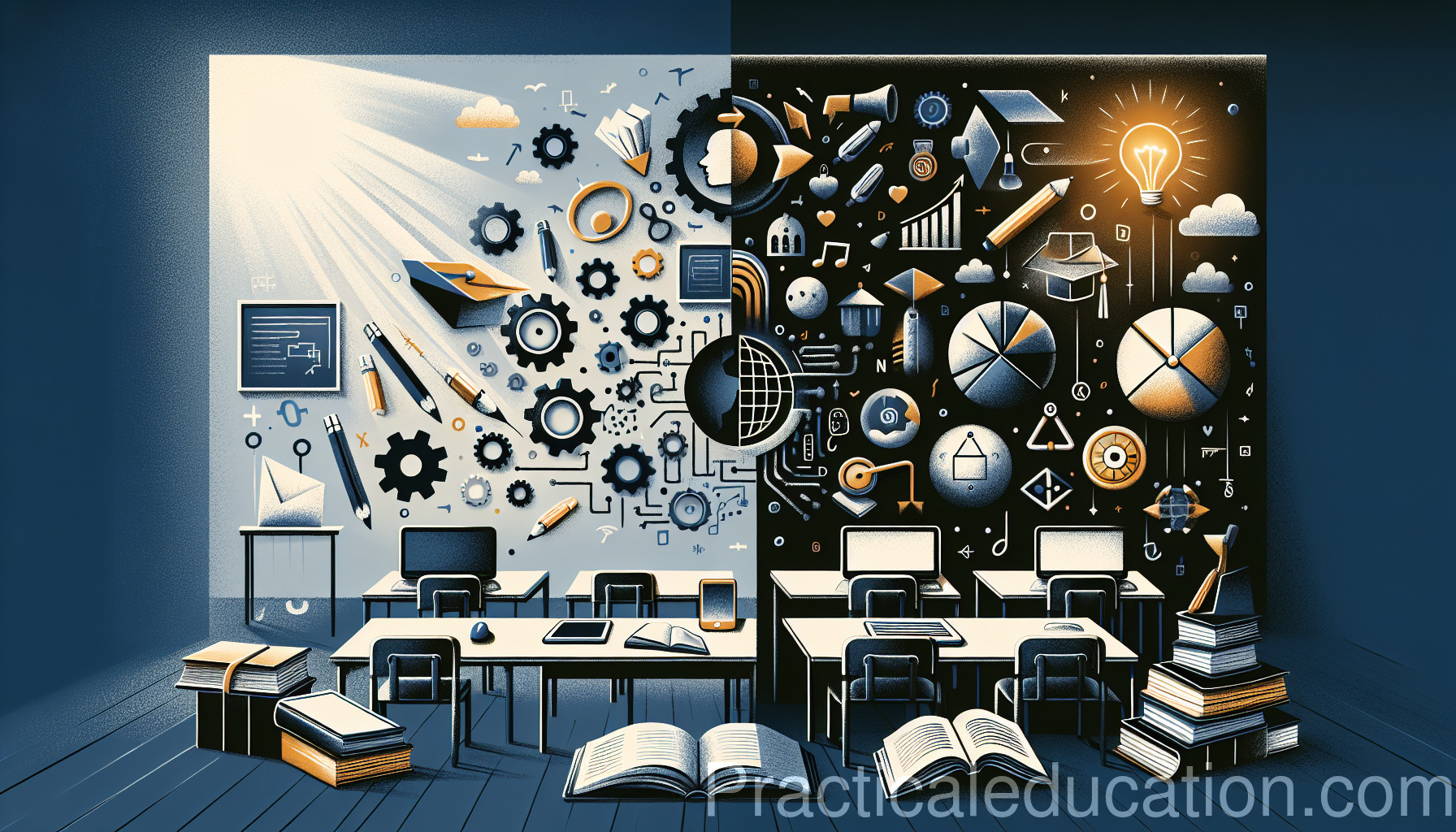
You have an idea? School will shrink it. You have a gift? School will grade it. The system is scared of scale—it loves predictability. But the world is built by wild thinkers. We must train for expansion, not control.
Traditional education often operates under the ethos of conformity and predictability, reflecting a deep-seated belief that success can be achieved through rigid adherence to a structured path.This framework prioritizes compliance and memorization over innovation and creativity, effectively shrinking the potential of students.
As institutions emphasize standard metrics, such as grades and test scores, they inadvertently send a powerful message: creativity is risky; taking initiative is discouraged; and true mastery lies within the bounds of established knowledge.
This chapter aims to deconstruct these myths surrounding conventional education and advocate for an expansive approach to learning—one that nurtures real-world skills, entrepreneurial spirit, and personal agency.
At the heart of the issue is the traditional view of education as a preparatory mechanism for employment, often shaped by economic models that emphasize stability over dynamism.
Consequently, schools have become environments that prioritize skills useful for narrow job descriptions rather than fostering an adaptive mindset conducive to entrepreneurship and the unpredictable nature of real-world challenges.
The insistence on uniformity leads not only to the stifling of creativity but also an inability to pivot in response to new information and changing market demands.
Current curriculum designs need to shift from rote learning to experiences that encourage experimentation and iterative learning processes, focusing on the development of critical thinking and problem-solving abilities.
Curriculum design must undergo a radical transformation to realign with the needs of a rapidly evolving global landscape.
Rather than using antiquated models focused on fixed disciplines and knowledge acquisition, the new curriculum should emphasize interdisciplinary learning that integrates technology, business acumen, and global citizenship.
Educational institutions should provide platforms for students to engage in projects that impact their local and global communities, thereby merging theoretical understanding with practical application.
This hands-on approach not only fosters individual growth but also cultivates a sense of responsibility toward broader societal concerns.
Students learn to see challenges as opportunities rather than obstacles, preparing them for life beyond the school walls.
A critical implication of this shift is the need to re-evaluate assessment methods.
Conventional assessments, typically quantifying knowledge retention through standardized testing, fail to capture the breadth of a student’s abilities.
The new model for evaluation should focus on portfolio-based assessments that reflect real-world achievements and competencies.
These portfolios should document projects, community engagement, and entrepreneurial endeavors, providing a more comprehensive picture of a student's capabilities.
Such assessments encourage students to take ownership of their learning journeys, fostering autonomy while simultaneously instilling the importance of output and results.
This eliminates the fear of failure associated with traditional grading systems and allows for a culture of innovation to thrive.
Educational institutions should transition from the role of gatekeepers to facilitators of knowledge.
This requires a shift in institutional culture—and the willingness to embrace diversity in thinking.
Schools must cultivate environments that welcome divergent viewpoints and multidisciplinary collaboration.
To facilitate this, educators need training that emphasizes the importance of guiding student inquiry rather than delivering content.
Professional development programs should be developed with a focus on fostering educational philosophies that prioritize lifelong learning, adaptability, and educational innovation.
Teachers who act as coaches or mentors, rather than traditional lecturing figures, can better support students in their pursuit of ownership over their educational trajectories.
This educational approach must acknowledge and embrace global perspectives while remaining contextually relevant.
Cultivating a global mindset involves integrating cultural intelligence into the curriculum, encouraging students to learn from differing economic and civic frameworks throughout the world.
By juxtaposing Western strategies of execution, focused on efficiency and outcomes, with Eastern philosophies emphasizing depth, patience, and adaptability, students can be better equipped to navigate a complex, interconnected world.
This duality not only fosters respect for varied traditions but also prepares students to adapt their approaches to problems, enhancing their capability for innovative thought.
In supporting student-driven, real-world learning, we can anticipate a new generation of professionals less hindered by fear of failure and more equipped to contribute innovatively to their fields.
This generation will possess the tools necessary to confront challenges head-on, harnessing their gifts for practical application.
Educational systems that embrace expansion rather than control will attract highly motivated individuals who prioritize learning over static credentials.
As they build a portfolio of skills that extend beyond traditional academic boundaries, they contribute to economies that value innovation and creativity.
In embedding this re-envisioned educational paradigm within institutional frameworks globally, we align education with 21st-century competencies demanded by an ever-evolving job market.
This requires an expansive reinterpretation of success in education.
As value shifts from mere credential attainment to practical mastery and contribution, we will witness a transformation in societal norms surrounding learning, creativity, and professional pathways.
Students will move from being passive recipients of information to active participants in knowledge creation and dissemination, leading to a more vibrant and dynamic society.
Ultimately, the goal of education should not merely be to maintain the status quo but to encourage the stretching of ideations and the expansion of possibilities.
The challenging notion that “school teaches you how to stay small” will be dismantled by bold new paradigms of learning that embrace creativity and real-world application.
The correct approach does not confine students to pre-packaged paths, but rather allows them to explore, innovate, and expand their understanding in ways that are deeply personal and broadly impactful.
In doing so, education can transcend the outdated confines of conformity and realize its true potential as a powerful engine for societal evolution.
"Education should expand horizons, not confine them to predetermined limits." — Eric Bach